Glass Bottle MOQ Explained: What First-Time Buyers Need to Know
Minimum order quantities (MOQ) are the number one concern for first-time glass bottle buyers. Learn why MOQs exist, what ranges to expect, and practical strategies to negotiate lower minimums.
Glass Bottle MOQ Explained: What First-Time Buyers Need to Know
Minimum Order Quantity — MOQ — is the single most common concern we hear from first-time glass container buyers. You find a bottle design you like, you reach out to the supplier, and the response comes back: "MOQ 30,000 pieces." If you are a startup, a small brand, or testing a new product line, that number can feel like a wall.
This article explains why MOQs exist, what realistic ranges look like for different product types, and — most importantly — seven practical strategies to get the quantities you actually need at a workable price.
Key Takeaways:
- MOQs exist primarily because of mold setup costs, furnace minimums, and production line changeover time
- Stock mold MOQs range from 1,000 to 15,000 units; custom mold MOQs start at 10,000 and can reach 100,000+
- Working with a trading company that sources from multiple factories can reduce effective MOQ by 50–70%
- Trial orders, semi-custom approaches, and shared production runs are proven strategies to lower minimums
- The cheapest per-unit price does not always mean the best deal — factor in storage, cash flow, and market demand
Why Do Glass Bottle MOQs Exist?
To negotiate MOQs effectively, you need to understand what drives them. A glass factory's minimums are not arbitrary — they are based on real production economics.
1. Mold Investment
Every glass bottle shape requires a mold set. A single mold set for a standard round bottle costs $800–$2,000 and produces roughly 150,000–300,000 pieces before needing replacement. The factory needs to amortize this mold cost across the production run. If you order 5,000 bottles, the mold cost alone adds $0.16–$0.40 per bottle. At 50,000 bottles, that drops to $0.02–$0.04.
2. Furnace Minimums
Glass factories operate continuous furnaces that run 24/7 at 1,400–1,600°C. A furnace holds 50–200 tons of molten glass. Restarting a cold furnace costs $500,000–$2,000,000 and takes 2–4 weeks. So factories cannot "pause" — they must maintain throughput. A production run that is too small wastes furnace capacity.
3. Line Changeover Costs
Switching from one product to another on a glass forming line takes 2–8 hours. During changeover, the line produces nothing, but the furnace keeps burning. The factory needs each production run to be long enough that changeover time is a small fraction of total run time. This is why small runs are less attractive.
4. Packaging and Logistics Efficiency
Export packaging, customs documentation, and container loading have fixed costs that are largely independent of order size. A full 20ft container holds 500–800 cartons of glass bottles. Shipping 100 cartons via LCL costs more per carton and involves additional handling, which increases breakage risk.
Realistic MOQ Ranges by Product Type
What MOQ should you actually expect? Here are realistic ranges based on glass container type and whether molds already exist.
| Product Category | Stock Molds (Existing) | Custom Molds (New) |
|---|---|---|
| Standard beverage bottles (round, 200–750ml) | 5,000–15,000 | 30,000–50,000 |
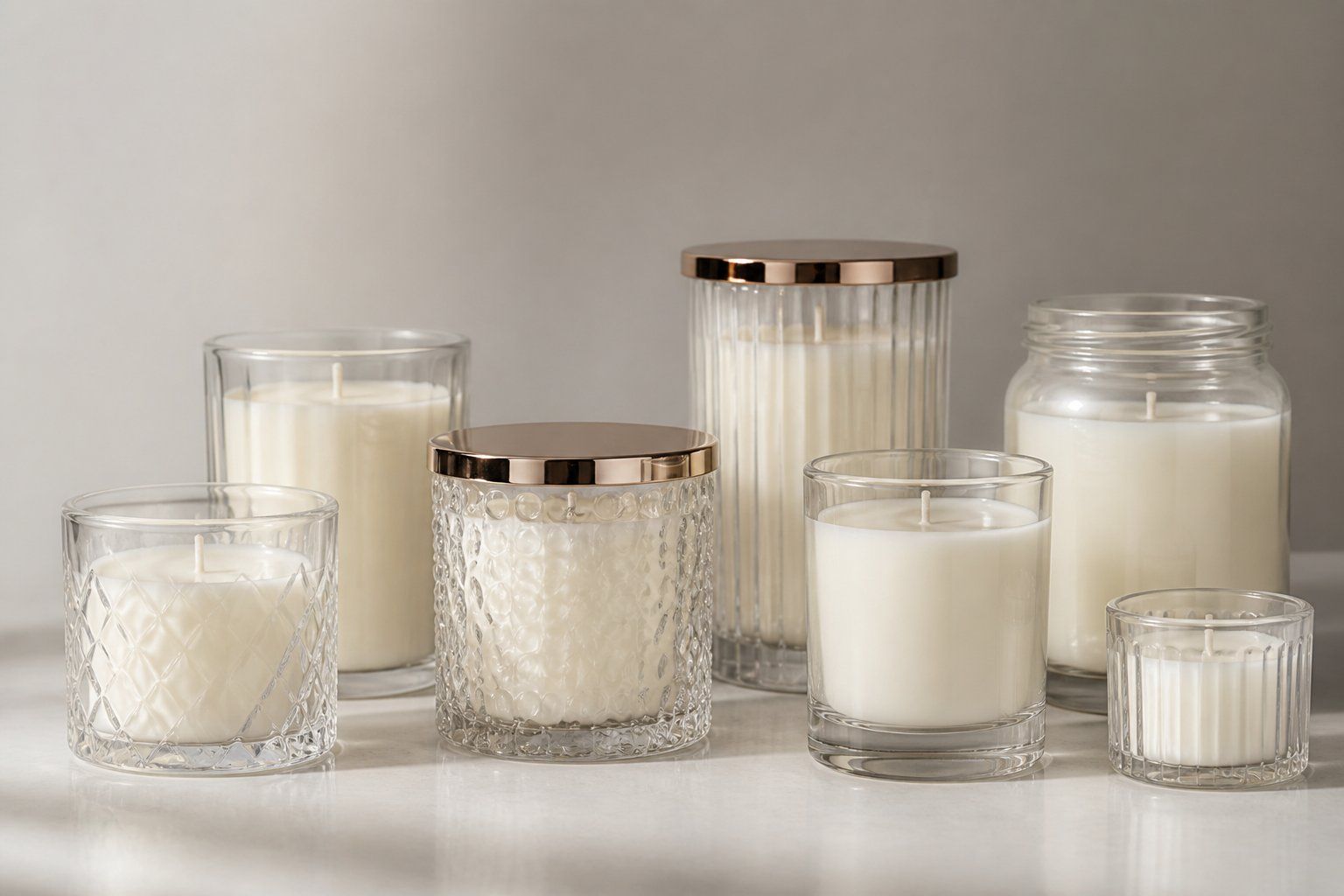
| Glass jars (mason, candle, spice) | 5,000–15,000 | 20,000–40,000 |
| Wine & liquor bottles | 5,000–20,000 | 50,000–100,000 |
| Cosmetic & perfume bottles | 3,000–10,000 | 10,000–30,000 |
| Glass vases & decorative | 1,000–5,000 | 5,000–15,000 |
| Pharmaceutical vials & ampoules | 50,000–200,000 | 500,000+ |
| Food sauce & oil bottles | 10,000–30,000 | 30,000–80,000 |
| Mini bottles (50–100ml) | 10,000–30,000 | 50,000–100,000 |
Important: These are single-factory numbers. If you work through a sourcing partner with multi-factory access — like HongChong Glass in the Xuzhou Tongshan Glass Industrial Zone — effective MOQs can be 50–70% lower because your order can be matched to a factory already running similar products.
7 Strategies to Lower Your Effective MOQ
Strategy 1: Start with Stock Molds
This is the single most effective way to reduce MOQ for your first order. Browse your supplier's existing mold catalog — also called "open molds" or "stock molds." These are shapes the factory already has tooling for. Since the mold investment is already made, the factory only charges for glass and production time.
HongChong Glass maintains a catalog of 500+ stock molds across bottles, jars, and vases. Most first-time buyers find a close match that requires little or no new tooling.
Strategy 2: Accept a Higher Unit Price for Low-Volume Orders
Factories can sometimes accept a lower MOQ if you pay a premium per unit. A bottle that costs $0.25 at 50,000 pieces might cost $0.40 at 5,000 pieces. The factory recovers its setup cost through the higher per-unit margin. Be transparent: say "I understand my quantity is below your standard MOQ. Can you offer a small-batch price?"
Strategy 3: Use a Multi-Factory Sourcing Model
A single factory can only run profitable production when your order matches their equipment and furnace capacity. A trading company or sourcing partner connected to multiple factories can:
- Match small orders to smaller factories with lower furnace minimums
- Combine your order with another buyer's (shared production run)
- Route complex multi-product orders to different specialized factories
This is exactly the model HongChong Glass operates in Xuzhou — we do not own a single factory; we partner with dozens, which means your 3,000-bottle order finds the right home.
Strategy 4: Semi-Custom Approach
If you need a unique design but cannot meet custom mold MOQ, consider semi-custom: start with a stock bottle shape and customize through decoration only. Options include:
- Silk-screen printing your logo (MOQ as low as 500–1,000 for manual printing)
- Frosted or colored spray coating
- Custom labels, neck tags, or hang tags
- Custom closure or cap color
- Custom packaging (boxes, sleeves, inserts)
You get a branded product without the mold investment.
Strategy 5: Order Samples First
Never skip the sample stage. Order 10–50 sample bottles — most suppliers provide samples free or at a nominal cost, though you pay shipping. Samples let you:
- Verify glass quality, clarity, and weight
- Test your filling line compatibility
- Check closure fit and seal integrity
- Take product photos for your marketing
- Confirm the bottle matches your brand vision
Strategy 6: Plan for Multiple SKUs from Day One
If your brand needs three bottle sizes (e.g., 100ml, 250ml, 500ml), and each has a 10,000-unit MOQ, your total order is 30,000 units — which is far more attractive to a factory than three separate 10,000-unit orders. Bundling SKUs can unlock better pricing, shared shipping, and sometimes reduced per-SKU MOQ.
Strategy 7: Build a Relationship — Start Small, Grow
Factories invest in relationships. A buyer who places a 5,000-unit trial order today and returns for 20,000 units in six months is worth more than a one-time 50,000-unit order. Be upfront about your growth plan. Good suppliers will accommodate smaller trial orders if they see a path to larger repeat business.
MOQ and Your Business Model
Before fixating on getting the lowest possible MOQ, think about what quantity actually makes sense for your business.
Calculate your true per-unit cost: Unit cost = (bottle price × quantity + mold amortization + freight + duties + warehousing) ÷ quantity
A $0.20 bottle at 50,000 MOQ that requires $5,000/year in warehousing because you only sell 10,000/year may cost more per unit sold than a $0.35 bottle at 5,000 MOQ with no storage cost.
Consider cash flow: Tying up $10,000 in inventory for 18 months is a real business cost. Sometimes the higher per-unit price of a smaller order is cheaper than the capital cost of excess inventory.
Test the market first: If you are launching a new product, start with a small order (1,000–5,000), test market response, then scale. The cost of unsold inventory is always higher than the premium you pay for a small initial run.
Frequently Asked Questions
Is there an absolute minimum MOQ for glass bottles? Not a fixed number, but practically: 1,000 units for simple stock items sourced through a multi-factory trading partner. Below 1,000 units, you are likely better off buying from a domestic wholesaler who already holds inventory.
Can I negotiate MOQ down from 50,000 to 5,000? Usually not directly — a 90% reduction is too large. But you can often find a different factory with a smaller furnace or use a stock mold instead of custom tooling to achieve the same effective result.
Does higher MOQ always mean lower per-unit price? Generally yes, but with diminishing returns. Moving from 10,000 to 50,000 units might cut unit price by 20–30%. Moving from 50,000 to 200,000 might only cut another 5–10%.
What if I need 5 different products in small quantities? This is where a multi-factory sourcing partner adds significant value. HongChong Glass routinely handles multi-SKU orders where each SKU is below a single factory's MOQ by routing each product to a different specialized factory.
Work with HongChong Glass
We understand that every buyer starts somewhere — and that MOQ is often the biggest barrier between you and your first glass container order. Based in the Xuzhou Tongshan Glass Industrial Zone, we leverage a network of specialized factories to offer flexible minimums, fast sampling, and competitive pricing for buyers at every stage.
Contact us today with your requirements, and we will find the right production solution — no matter your order size.